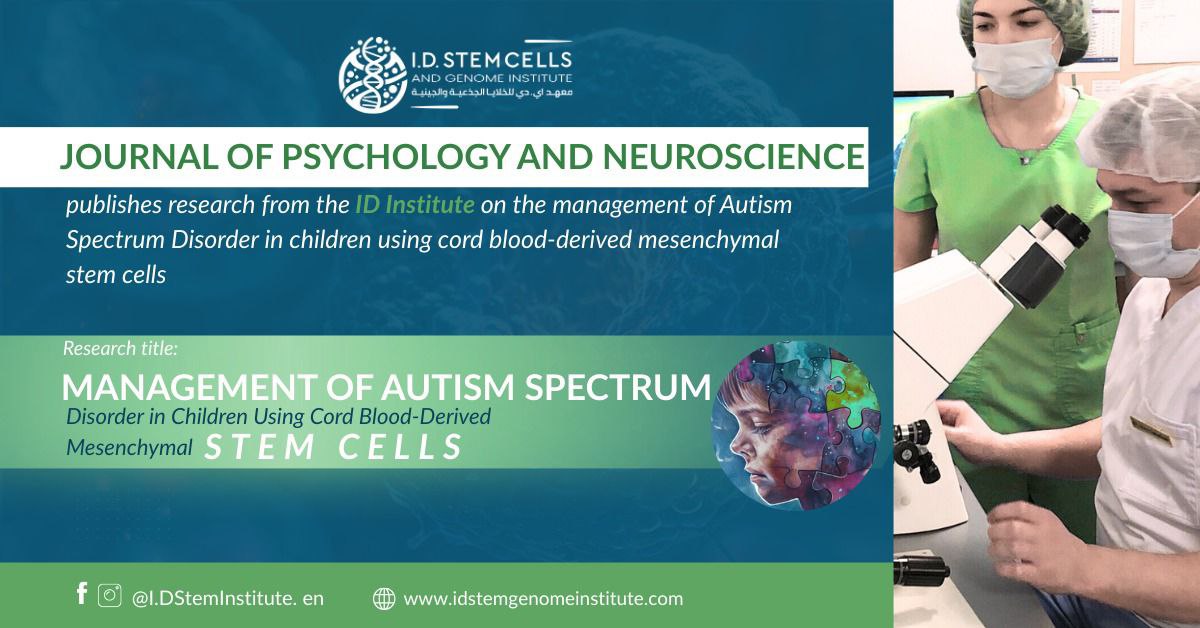
A new research study aimed at understanding and managing Autism Spectrum Disorder in children, conducted by a team of specialized scientists and researchers at the ID Stem Cell and Genome Institute, has been published in the Journal of Psychology and Neuroscience
Research summary:
Introduction:
Autism Spectrum Disorder (ASD) is a neurodevelopmental condition characterized by impaired social interaction, communication challenges, and repetitive behaviors. Current treatments focus on behavioral management and symptom alleviation, with no curative options available. This study explored the safety and efficacy of umbilical cord blood-derived mesenchymal stem cells (UC-MSCs) as a potential therapeutic intervention for ASD in children.
Methods:
This single-arm Phase JH clinical trial included 27 children aged 2.5 to 12 years diagnosed with ASD according to DSM-5 criteria. Participants received four subcutaneous injections of UC-MSCs at three-month intervals, with a dosage of 2 million neural cells per kilogram of body weight per injection, prepared in a sterile suspension until recovery. Stem cells were isolated from screened umbilical cords under standardized protocols and manufactured under Good Manufacturing Practice (GMP) conditions.
Outcomes were assessed at baseline, 5, 6, and 12 months post-treatment, with final follow-up at 21 months. Safety evaluations included adverse event monitoring, complete blood counts, metabolic panels, and inflammatory markers (MDC, TIMC). Efficacy was measured using standardized ASD-specific tools (e.g., CARS, ATEC, ERDO), cognitive scales (BPPSPADL), behavioral measures (YABS, ABC), and quality-of-life assessments (PedoQL). Statistical analyses employed repeated measures MANOVA to identify symptom trends over time. Missing data were addressed using Little’s MCMR test and the EM algorithm.
Research summary:
Introduction:
Autism Spectrum Disorder (ASD) is a neurodevelopmental condition characterized by impaired social interaction, communication challenges, and repetitive behaviors. Current treatments focus on behavioral management and symptom alleviation, with no curative options available. This study explored the safety and efficacy of umbilical cord blood-derived mesenchymal stem cells (UC-MSCs) as a potential therapeutic intervention for ASD in children.
Methods:
This single-arm Phase JH clinical trial included 27 children aged 2.5 to 12 years diagnosed with ASD according to DSM-5 criteria. Participants received four subcutaneous injections of UC-MSCs at three-month intervals, with a dosage of 2 million neural cells per kilogram of body weight per injection, prepared in a sterile suspension until recovery. Stem cells were isolated from screened umbilical cords under standardized protocols and manufactured under Good Manufacturing Practice (GMP) conditions.
Outcomes were assessed at baseline, 5, 6, and 12 months post-treatment, with final follow-up at 21 months. Safety evaluations included adverse event monitoring, complete blood counts, metabolic panels, and inflammatory markers (MDC, TIMC). Efficacy was measured using standardized ASD-specific tools (e.g., CARS, ATEC, ERDO), cognitive scales (BPPSPADL), behavioral measures (YABS, ABC), and quality-of-life assessments (PedoQL). Statistical analyses employed repeated measures MANOVA to identify symptom trends over time. Missing data were addressed using Little’s MCMR test and the EM algorithm.

Results:
UC-MSC therapy demonstrated a favorable safety profile, with no severe treatment-related adverse events. Of 324 administered doses, 135 adverse events were recorded, with 20.4% deemed treatment-related, including mild injection site inflammation and transient behavioral increases (e.g., aggression, anxiety). These events were mild and self-limiting.
Efficacy assessments revealed significant reductions in autism severity over time. At the 12-month follow-up, mean CARS scores decreased by 7 points (from 39.5 to 32.0), and ATEC scores improved by 23 points (from 62.8 to 40.0). These improvements correlated with clinical observations, with 41% of participants achieving a meaningful reduction in CARS scores that moved them to a lower diagnostic category for autism severity. Among responders, 63.8% transitioned from mild-moderate autism to below the diagnostic threshold, while 36.4% improved from severe autism to sub-threshold levels.
Inflammatory markers MDC and TABC decreased by 150.00 pg/mL and 65.00 pg/mL, respectively. These reductions were associated with behavioral and cognitive improvements, suggesting an immunomodulatory mechanism of action.
By 21 months, partial regression in symptoms and inflammatory marker levels was observed, with scores stabilizing but remaining improved compared to baseline. Notably, 11 participants (41%) maintained sustained gains.
Results:
UC-MSC therapy demonstrated a favorable safety profile, with no severe treatment-related adverse events. Of 324 administered doses, 135 adverse events were recorded, with 20.4% deemed treatment-related, including mild injection site inflammation and transient behavioral increases (e.g., aggression, anxiety). These events were mild and self-limiting.
Efficacy assessments revealed significant reductions in autism severity over time. At the 12-month follow-up, mean CARS scores decreased by 7 points (from 39.5 to 32.0), and ATEC scores improved by 23 points (from 62.8 to 40.0). These improvements correlated with clinical observations, with 41% of participants achieving a meaningful reduction in CARS scores that moved them to a lower diagnostic category for autism severity. Among responders, 63.8% transitioned from mild-moderate autism to below the diagnostic threshold, while 36.4% improved from severe autism to sub-threshold levels.
Inflammatory markers MDC and TABC decreased by 150.00 pg/mL and 65.00 pg/mL, respectively. These reductions were associated with behavioral and cognitive improvements, suggesting an immunomodulatory mechanism of action.
By 21 months, partial regression in symptoms and inflammatory marker levels was observed, with scores stabilizing but remaining improved compared to baseline. Notably, 11 participants (41%) maintained sustained gains.

Conclusion:
UC-MSC therapy exhibited a favorable safety profile and potential efficacy in alleviating core ASD symptoms and improving comorbidities. While results are promising, the small sample size and lack of a control group warrant further research in larger randomized trials. This study highlights the potential of stem cell therapies as innovative interventions for ASD management.
Conclusion:
UC-MSC therapy exhibited a favorable safety profile and potential efficacy in alleviating core ASD symptoms and improving comorbidities. While results are promising, the small sample size and lack of a control group warrant further research in larger randomized trials. This study highlights the potential of stem cell therapies as innovative interventions for ASD management.