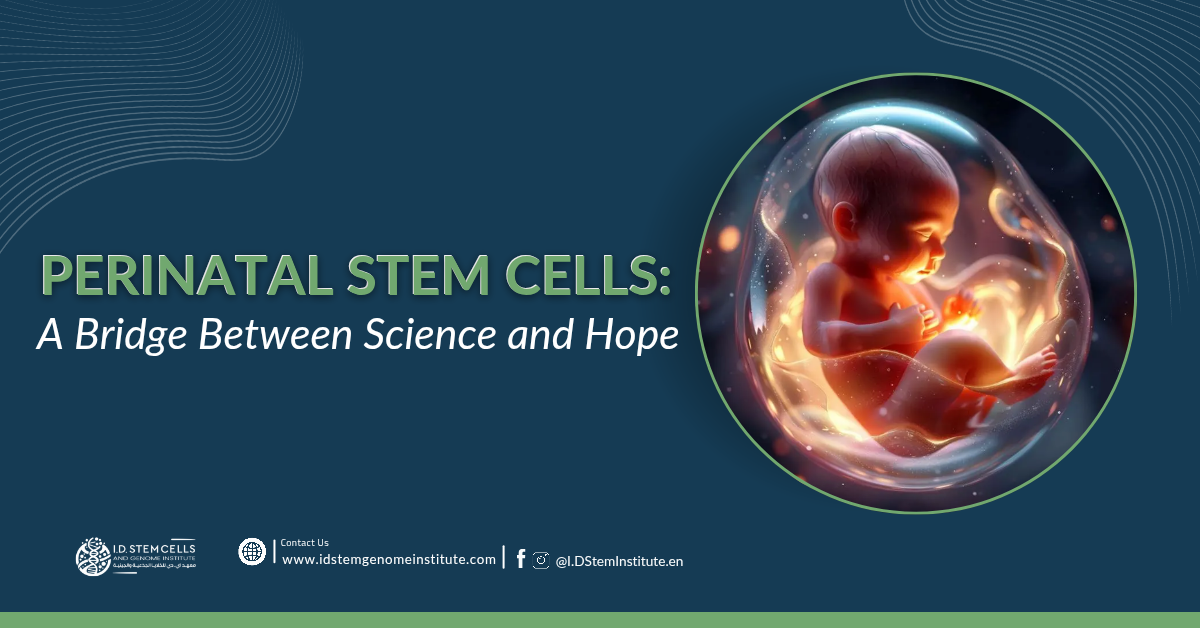
In the world of regenerative medicine, where scientific dreams are hatched to repair damaged tissues and restore lost functions, perinatal stem cells emerge as a promising star, combining diverse advantages.
These cells are derived from tissues associated with fetal and perinatal development, such as amniotic fluid, placenta, and umbilical cords. They represent a rich and ethically uncontroversial source compared to other sources such as embryonic stem cells. Perinatal stem cells belong to a unique class that combines the properties of embryonic stem cells

(capable of developing into any cell type) and adult stem cells (specialized in specific tissues). They possess "hybrid potential," capable of differentiating into multiple cell types, but to a lesser extent than embryonic cells, making them safer for application. These cells are derived from tissues considered "medical waste" after birth, such as the umbilical cord, which was previously discarded. These cells are now a biological treasure stored in special banks for future use.
The Secret of Strength: Flexibility and Ethical Integrity
One of the revolutionary advantages of these cells is their ethically non-controversial nature. Obtaining them does not require the destruction of embryos, but is extracted from tissue left over after natural birth. Furthermore, they possess a high immunological adaptability, secreting chemicals that mitigate the immune response of the recipient, allowing them to be transplanted into other bodies without the need for a perfect match between donor and patient. This property heralds the possibility of creating "cell banks" ready for immediate use in various treatments, without the long wait for matching. The potential uses of these cells are expanding to include fascinating areas. In regenerative medicine, they can repair damaged heart tissue after strokes or regenerate degenerated joint cartilage. In neurological diseases, such as cerebral palsy, experiments are underway to use them to replace dead neurons or stimulate brain damage repair. In diabetes patients, their ability to transform them into insulin-producing pancreatic cells is being tested. Even in skin diseases, such as severe burns, these cells can accelerate wound healing by secreting growth factors that stimulate cell regeneration.
The Secret of Strength: Flexibility and Ethical Integrity
One of the revolutionary advantages of these cells is their ethically non-controversial nature. Obtaining them does not require the destruction of embryos, but is extracted from tissue left over after natural birth. Furthermore, they possess a high immunological adaptability, secreting chemicals that mitigate the immune response of the recipient, allowing them to be transplanted into other bodies without the need for a perfect match between donor and patient. This property heralds the possibility of creating "cell banks" ready for immediate use in various treatments, without the long wait for matching. The potential uses of these cells are expanding to include fascinating areas. In regenerative medicine, they can repair damaged heart tissue after strokes or regenerate degenerated joint cartilage. In neurological diseases, such as cerebral palsy, experiments are underway to use them to replace dead neurons or stimulate brain damage repair. In diabetes patients, their ability to transform them into insulin-producing pancreatic cells is being tested. Even in skin diseases, such as severe burns, these cells can accelerate wound healing by secreting growth factors that stimulate cell regeneration.
Future Challenges and Hopes
Despite the enormous potential, research is still in its intermediate stages. Understanding the precise mechanism that controls cell differentiation into specific tissues requires further study, and ensuring the safety of long-term use remains a priority. However, preliminary results are encouraging. In a recent Chinese study, scientists were able to use placental cells to treat lung failure in premature infants, while other experiments in Japan have successfully restored liver function using cells from umbilical cords. Non-congenital stem cells are not merely an ethical alternative or compromise; they are a model for transforming "biological waste" into lifesaving tools. With advances in genetic engineering and personalized medicine, these cells may become the basis for personalized treatments for each patient, implanting cells derived from the patient's placenta or umbilical cord itself, ensuring greater efficacy and fewer complications. In this scenario, the role of science is not simply to repair the body, but rather as a visionary, building a bridge between a life threatened by disease and a life filled with new possibilities.
Future Challenges and Hopes
Despite the enormous potential, research is still in its intermediate stages. Understanding the precise mechanism that controls cell differentiation into specific tissues requires further study, and ensuring the safety of long-term use remains a priority. However, preliminary results are encouraging. In a recent Chinese study, scientists were able to use placental cells to treat lung failure in premature infants, while other experiments in Japan have successfully restored liver function using cells from umbilical cords. Non-congenital stem cells are not merely an ethical alternative or compromise; they are a model for transforming "biological waste" into lifesaving tools. With advances in genetic engineering and personalized medicine, these cells may become the basis for personalized treatments for each patient, implanting cells derived from the patient's placenta or umbilical cord itself, ensuring greater efficacy and fewer complications. In this scenario, the role of science is not simply to repair the body, but rather as a visionary, building a bridge between a life threatened by disease and a life filled with new possibilities.