Bone cancer is a heterogeneous group of tumors that can be benign or malignant. Malignant bone cancers, which arise from bone or cartilage, account for approximately 0.2% of malignant tumors. They can be classified into different types, such as osteosarcoma, chondrosarcoma, and Ewing sarcoma, which differ primarily in their histological structure and age of onset.
Types of Bone Cancer
Osteosarcoma (OS): This is the most common type of primary bone cancer, most often affecting children and young adults, particularly in the long bones. Osteosarcoma accounts for 42% of bone cancers worldwide and most often occurs in the femur. The five-year survival rate for this type of osteosarcoma is approximately 40%.
Chondrosarcoma (CHS): This is another type of bone cancer that arises from cartilage cells. It is usually less aggressive than osteosarcoma, with a five-year survival rate of about 70%. Like osteosarcoma, it has a five-year survival rate of about 40%.
Other types: Other types of bone cancers include chordoma and malignant fibrosarcoma, although they are less common.

Causes and risk factors
Although the causes of most bone cancers are still not fully understood, some specific risk factors include:
-
Radiation therapy: Previous radiation therapy is associated with an increased risk of osteosarcoma.
-
Genetics: While most bone cancers do not have significant environmental risk factors, some cases are linked to genetic conditions.
Types of Bone Cancer
Osteosarcoma (OS): This is the most common type of primary bone cancer, most often affecting children and young adults, particularly in the long bones. Osteosarcoma accounts for 42% of bone cancers worldwide and most often occurs in the femur. The five-year survival rate for this type of osteosarcoma is approximately 40%.
Chondrosarcoma (CHS): This is another type of bone cancer that arises from cartilage cells. It is usually less aggressive than osteosarcoma, with a five-year survival rate of about 70%. Like osteosarcoma, it has a five-year survival rate of about 40%.
Other types: Other types of bone cancers include chordoma and malignant fibrosarcoma, although they are less common.
Causes and risk factors
Although the causes of most bone cancers are still not fully understood, some specific risk factors include:
-
Radiation therapy: Previous radiation therapy is associated with an increased risk of osteosarcoma.
-
Genetics: While most bone cancers do not have significant environmental risk factors, some cases are linked to genetic conditions.
Symptoms
Pain: Pain is the most common symptom in patients with bone metastases and is a unique type of pain that does not respond to many standard strategies used to manage acute and chronic pain.
Pathological fractures: Pathological fractures occur within abnormal bones and are often caused by minimal or non-traumatic trauma. Therefore, energy-related fractures should always be considered. Minor or harmless trauma, and those with signs, symptoms, or a medical history of malignancy.
Epidemiology
Cancers arising from bone or cartilage represent approximately 0.5% of all malignant tumors in humans. Osteoma and Ewing sarcoma occur primarily in children and young adults, while other bone cancers occur in older adults. The common occurrence of bone metastases indicates that bone is a preferential site for metastatic cancers such as breast, prostate, and lung.
Symptoms
Pain: Pain is the most common symptom in patients with bone metastases and is a unique type of pain that does not respond to many standard strategies used to manage acute and chronic pain.
Pathological fractures: Pathological fractures occur within abnormal bones and are often caused by minimal or non-traumatic trauma. Therefore, energy-related fractures should always be considered. Minor or harmless trauma, and those with signs, symptoms, or a medical history of malignancy.
Epidemiology
Cancers arising from bone or cartilage represent approximately 0.5% of all malignant tumors in humans. Osteoma and Ewing sarcoma occur primarily in children and young adults, while other bone cancers occur in older adults. The common occurrence of bone metastases indicates that bone is a preferential site for metastatic cancers such as breast, prostate, and lung.
Diagnosis
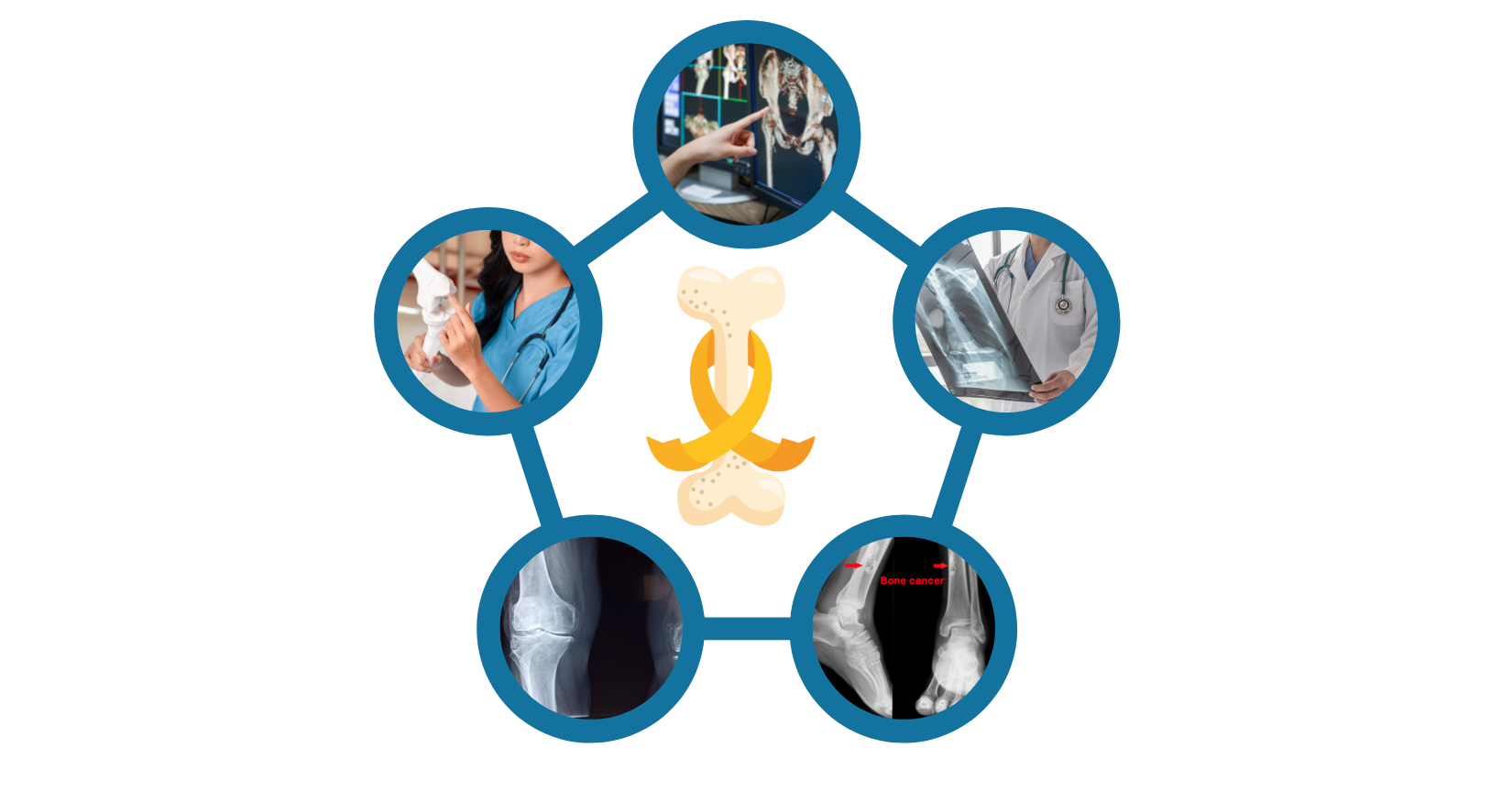
Imaging techniques are essential for the diagnosis and treatment of bone tumors. X-rays and magnetic resonance imaging (MRI) are useful in detecting and evaluating bone tumors. Additionally, a deep learning model based on radiographic images can improve the performance of radiologists in classifying the histological types of primary bone tumors.
For example, a radiograph of the proximal right femur of a 13-year-old boy with chondrosarcoma shows that, with the help of the model, all radiologists (Rad1 - Rad4) correctly identified it as CGT after model assistance, while radiologists (Rad1 - Rad4) made different assessments without model assistance.
Treatment
Therapeutic strategies include surgical tumor resection, chemotherapy, and radiotherapy. These treatments aim to reduce pain, decrease skeletal recurrence, and improve quality of life. Radiotherapy is one of the therapeutic modalities for treating metastatic bone disease.
After bone tumor resection, challenges arise in bone regeneration. Mesenchymal stem cells (MSCs) offer immunoregulatory and bone regeneration potential after tumor resection in osteosarcoma patients. MSCs can migrate mediated by PDGFs (platelet-derived growth factors) and SDF-1 chemotactics. Chemotactics are substances that attract cells, in this case, MSCs, to the site of bone injury or remodeling.

Future Directions
Green Metallic Nanoparticles: The ability to precisely manipulate the shape, size, charge, and surface modification of metal nanoparticles (MNPs) enables the development of improved therapeutics.
- Targeted Therapies: Researchers are exploring ways to engineer small-molecule and protein-based drugs to more effectively target bone tumors.
- Mathematical Models: Mathematical and computational models can replicate bone remodeling, metastasis, and pharmacokinetic/pharmacodynamic drug therapy.
In conclusion, bone cancer is a complex and multifaceted disease that requires a comprehensive understanding of its types, causes, and treatment.
Diagnosis
Imaging techniques are essential for the diagnosis and treatment of bone tumors. X-rays and magnetic resonance imaging (MRI) are useful in detecting and evaluating bone tumors. Additionally, a deep learning model based on radiographic images can improve the performance of radiologists in classifying the histological types of primary bone tumors.
For example, a radiograph of the proximal right femur of a 13-year-old boy with chondrosarcoma shows that, with the help of the model, all radiologists (Rad1 - Rad4) correctly identified it as CGT after model assistance, while radiologists (Rad1 - Rad4) made different assessments without model assistance.
Treatment
Therapeutic strategies include surgical tumor resection, chemotherapy, and radiotherapy. These treatments aim to reduce pain, decrease skeletal recurrence, and improve quality of life. Radiotherapy is one of the therapeutic modalities for treating metastatic bone disease.
After bone tumor resection, challenges arise in bone regeneration. Mesenchymal stem cells (MSCs) offer immunoregulatory and bone regeneration potential after tumor resection in osteosarcoma patients. MSCs can migrate mediated by PDGFs (platelet-derived growth factors) and SDF-1 chemotactics. Chemotactics are substances that attract cells, in this case, MSCs, to the site of bone injury or remodeling.
Future Directions
Green Metallic Nanoparticles: The ability to precisely manipulate the shape, size, charge, and surface modification of metal nanoparticles (MNPs) enables the development of improved therapeutics.
- Targeted Therapies: Researchers are exploring ways to engineer small-molecule and protein-based drugs to more effectively target bone tumors.
- Mathematical Models: Mathematical and computational models can replicate bone remodeling, metastasis, and pharmacokinetic/pharmacodynamic drug therapy.
In conclusion, bone cancer is a complex and multifaceted disease that requires a comprehensive understanding of its types, causes, and treatment.